

Careers
Five companies. One employer.
More than 1,200 people work here — designers, engineers, joiners, site teams and developers. Because all five sit under one roof, a career can move between them without changing employer.
Why here
Most people in this industry spend a career on one side of a wall — drawing but never building, or building someone else’s drawing and inheriting its mistakes. Here the wall is not there. The studio that draws a house, the contractor that builds it and the workshop that makes its joinery are the same group, in the same meetings, answering for the same result.
That has a practical consequence for a career. A young engineer sees how a detail is drawn and why; a joiner sees the house the panel is going into; a designer learns what the drawing costs to build. It is the fastest way we know to make someone genuinely good at this, and it is why senior people here tend to stay.
Where people work
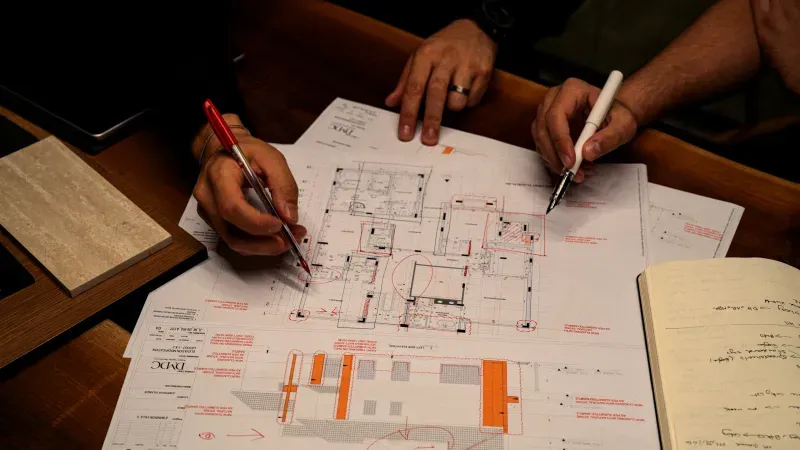 01 — The studio
Design & Architecture
Architects, interior designers, technical draughtsmen, visualisers.
The company ↗
01 — The studio
Design & Architecture
Architects, interior designers, technical draughtsmen, visualisers.
The company ↗
 02 — The site
Contracting
Project and site managers, engineers, quantity surveyors, QA and safety.
The company ↗
02 — The site
Contracting
Project and site managers, engineers, quantity surveyors, QA and safety.
The company ↗
 03 — The workshop
Woodworks
Cabinetmakers, machinists, finishers, CNC programmers, installers.
The company ↗
03 — The workshop
Woodworks
Cabinetmakers, machinists, finishers, CNC programmers, installers.
The company ↗
 04 — The group
Estates & central
Development, commercial, procurement, finance, technology and client care.
The company ↗
04 — The group
Estates & central
Development, commercial, procurement, finance, technology and client care.
The company ↗
What we look for
Four things a CV will not tell us.
You finish things properly
Most of the quality in a house shows up at the end — the alignments, the joins, the snagging list. Getting to nearly finished is easy. We hire people who keep going.
You keep what you see to yourself
We work inside private homes. What you see on site is never discussed off it — not with friends, not online, not ever.
You take being corrected well
Work here is reviewed openly and often. That only works with people who would rather be put right than be right.
You ask about other people’s trades
The engineers who ask the joiners questions turn into the better engineers. We hire for that habit.
How we work with each other
A settled person builds better than a frightened one.
This industry runs on pressure, and most companies pass it downward. Deadlines arrive as blame, mistakes get buried instead of raised, and people learn that the safe move is to say nothing. We have built the group on the opposite assumption.
The pressure here is real and we do not pretend otherwise. What we can decide is what a person does with it. Someone who is steady in themselves delegates properly, makes a decision without circling it for a week, and raises the difficult thing early enough for it to still be fixable. Someone working from fear does none of those, and the cost lands on a building site.
So DMDC funds personal development training for every member of the leadership team. It is not management training. It is about the person — the beliefs and habits that decide how someone responds when a project goes wrong.
The founder went first
Raji had been doing this himself for some time before offering it to anyone else. The offer exists because he found it useful, not because it reads well.
We are told nothing
What is said stays private to the person taking it. No reports come back, no summaries, no themes. The company pays for something it is not allowed to see.
Nobody has to
Taking it up or leaving it has no bearing on anyone’s position, review or prospects. It is not an assessment, and it is not a signal that something is wrong.
What the training looks at
“I need to handle everything myself for it to be done properly.”
“Delegating means losing control.”
“I should avoid difficult conversations because they create conflict.”
“I cannot afford to make a mistake.”
Beliefs like these are rarely conscious, and most of them were useful once — they are often the habits that got someone promoted in the first place. They stop being useful as responsibility grows.
Left alone, each one turns into something visible on a project. Work that cannot be handed over. A decision that waits a fortnight. A problem raised at handover that was known at first fix. Micromanagement, defensiveness, a manager carrying what the team should be carrying.
This is on a careers page rather than in a memo because it changes what the job feels like. Work here is reviewed openly and often. That only holds together if being corrected is not frightening.
Applying
We do not advertise vacancies here.
We hire steadily rather than in campaigns, and much of it happens from applications already on file. Write whether or not anything is open — a good one is kept and read again when something is.
Where a role is advertised, it is posted on our LinkedIn.
How to apply
One address, read by a person.
Send a CV and, if your work is visual, a portfolio. Tell us which of the five companies interests you and why that one. We read everything that arrives and reply to the applications we want to take further.
Applications are held in confidence and used only for recruitment. We never ask for payment at any stage of hiring, and no agency is authorised to charge a candidate on our behalf.